Investing in a Nurse Strengthens a Community

Irene Zijp • April 15, 2026

 Safer care for mothers and newborns in Ndegeya

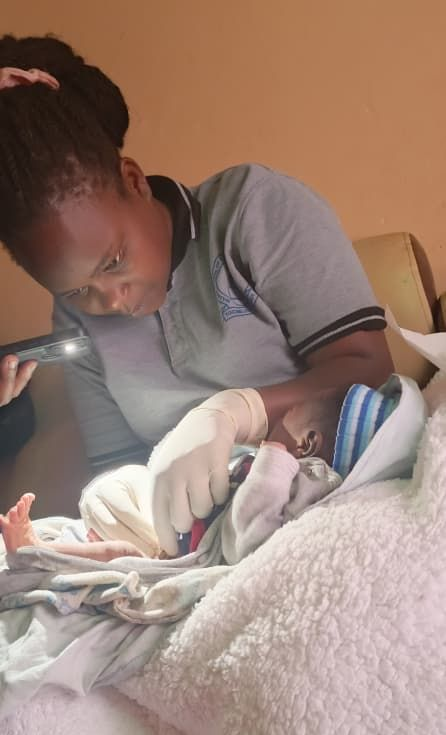
Miriam is the midwife at the Mother and Childcare Centre in Ndegeya whose current training is being supported by Laudara and the Joanne Foundation. Her story shows very concretely how an investment in education leads to better care for mothers and babies, starting from the very first hours after birth.


From student to trusted nurse

As part of her nursing diploma, Miriam follows a special “domiciliary” programme at Masaka Regional Referral Hospital. Under the supervision of an experienced hospital mentor, she starts supporting a woman in labour from the moment the cervix is about 4 centimetres dilated. From that point on, Miriam carefully monitors the progress of the labour, the well‑being of the mother and the condition of the baby, right through to the birth. Her learning does not stop at the delivery itself. After the baby is born, Miriam continues to observe both mother and child on the ward until the moment of discharge from the hospital. She learns to recognise early signals of problems, to offer reassurance, and to give basic health education – for example about breastfeeding, hygiene and cord care


Accompanying mother and baby home

A unique part of Miriam’s training is that she does not say goodbye at the hospital gate. When the mother and baby are discharged, Miriam and a fellow nursing student actually accompany them home. This home visit allows her to see the living situation: is there a clean sleeping place for the baby, is there water available to wash hands, who else is in the household who can help the mother? The next day, Miriam returns and starts a week‑long follow‑up: She monitors the same mother and baby and observes how both are recovering and adapting. Each day she writes down her findings and offers targeted health education about topics such as personal hygiene after birth, breastfeeding, danger signs, and how to care for the baby’s umbilical cord.


Learning by closely following three mothers

During this domiciliary programme, Miriam is required to follow three different mothers in this intensive way. Nurses are paired and always go together to the house of the new mother, which makes the visits safer and gives them the chance to reflect on what they see and learn from each other. Their school supervisors come out specifically on day 3 and day 7 of the follow‑up period to supervise, ask questions, and assess whether the students are ready to discharge the mother from their care.

By following the same families for a full week, Miriam gains a deep understanding of the changes that happen in the first days after birth. She learns to recognise what is normal, what needs extra attention, and when it is crucial to refer a mother or baby back to the health facility.


Why cord care education matters

One important part of Miriam’s health education is teaching mothers how to care properly for the baby’s umbilical cord. Good cord care reduces the risk of infection, which is one of the main causes of serious illness and even death in newborns in many low‑resource settings. In her home visits, Miriam can take time to demonstrate simple steps, answer questions, and gently correct harmful traditional practices if they are present.

Because she knows the mother personally and has been present from labour to the first week at home, her advice carries weight. The trust built during this period makes it easier for mothers to ask questions they might not dare ask in a busy hospital ward, and helps to create lasting habits that protect both mother and child.


The impact of supporting training

For Laudara, supporting Miriam’s nursing diploma is more than helping one student get a certificate. It means that mothers in and around Ndegeya receive more attentive, knowledgeable care at the most vulnerable time of their lives – from the first contractions to the first week at home with a newborn. The skills Miriam is now mastering in Masaka will return every day to the Mother and Childcare Centre, where she can put them into practice and share them with colleagues.

In this way, an investment in education becomes an investment in an entire community: healthier babies, stronger mothers, and a local health system that keeps learning and improving. Miriam’s path from student to confident nurse shows how powerful that connection can be.
Share this post:

By Irene Zijp May 4, 2026
How Ndegeya Community Clinic is expanding its reach and transforming healthcare
By Irene Zijp March 22, 2026
Empowering Women Farmers 2026
By Irene Zijp March 1, 2026
Empowering Youth Through Health Education
By Irene Zijp February 8, 2026
NCC’s Efforts to Support Ndegeya’s Communities
By Irene Zijp February 5, 2026
Growing Hope from Doorsteps
By Irene Zijp January 27, 2026
How the Idea of a Community Mill Began
By Kelly Brantner January 24, 2026
Laudara's 2026 Community Milling Initiative
Hands preparing a syringe for injection; white background with blurred text.
By Irene Zijp December 29, 2025
Ndegeya Now Vaccinates On-Site 
A group of people sitting outdoors on a bench. They are gathered in a green space.
By Irene Zijp November 11, 2025
Working with and through the local experts
By Irene Zijp October 28, 2025
Laudara Foundation supports new mothers with baby packs